
The Most-Used Router Bits for Signmaking: A Complete Guide
Signmaking sits at the intersection of woodworking and precision machining. Whether you're carving raised-letter cedar signs by hand, running a CNC router to cut dimensional lettering in HDU, or engraving fine text into plastic and aluminum plaques, the router bit you choose determines your line quality, your V-groove depth, your edge finish, and ultimately how professional the final piece looks. Below is a rundown of the bit categories that see the most use on the signmaking bench, with real product examples from Holbren, a Whiteside Machine dealer that stocks the full signmaking lineup.
1. V-Groove Router Bits
V-groove bits are the single most iconic signmaking tool. Chucked into a CNC router (or used freehand with a V-carving system), they cut a wedge-shaped groove whose width changes with plunge depth — which is exactly what gives V-carved lettering its classic tapered, engraved look. They're used constantly for lettering, borders, decorative line work, and chamfering panel edges.
 Whiteside 1502 90° V-Groove Router Bit, 1/2" cutting diameter
V-groove bits are sold by included angle, and each angle serves a different purpose:
- 90° bits (like the Whiteside 1500–1508 series) are the sign shop workhorse — they produce a wide, shallow, sharply tapered groove that's ideal for bold V-carved lettering and decorative panel lines.
- 60° bits (Whiteside 1540, 1541, 1550, 1560) cut a narrower, deeper groove for finer detail work and smaller lettering.
- Two-flute vs. three-flute versions (1540 vs. 1541) trade a bit of finish quality for feed speed — three-flute bits can be run faster for the same surface finish.
 Whiteside 1540 60° V-Groove Router Bit, 1/4" cutting diameter
For CNC signmaking specifically, insert-style V-groove bits with interchangeable carbide tips (like the Amana AMS-150 and AMS-225 series, which pack 45°, 60°, 90°, and 120° inserts in one holder) are extremely popular because a single shank swaps angles in seconds instead of requiring a full tool change.
2. Engraving Bits (Pencil-Point & Flat-Point)
Where V-groove bits give a sign its carved look, dedicated engraving bits are for fine detail: small text, logos, and intricate line art where a standard V-groove bit's mass would blow out delicate features. These bits have a much finer point geometry ground specifically for shallow-depth, high-precision cuts.
 Whiteside SC70 30° Pencil Point Engraving Router Bit
Holbren's engraving lineup covers both point styles at two common angles:
- Pencil point (SC70 at 30°, SC75 at 45°) leaves a rounded groove bottom, softer and more forgiving for small-scale carving.
- Flat point (SC71 at 30°, SC76 at 45°) leaves a small flat at the bottom of the cut, useful when you want a consistent line width regardless of plunge depth — common in single-line engraved text.
 Whiteside SC71 30° Flat Point Engraving Router Bit
These bits are commonly run in wood, HDU, acrylic, and even aluminum and Corian for interior signage and awards work.
3. Round Nose (Core Box) Bits
Round nose bits — also called core box bits — cut a smooth, semicircular groove. In signmaking they're used for softer, sculpted lettering styles (as opposed to the crisp taper of a V-groove), for decorative fluting and borders, and for carving dimensional elements like leaves, scrolls, and rope-style edge details on routed signs.
 Whiteside 1404 Round Nose Router Bit, 1/4" radius
They're specified by radius rather than angle, and Holbren stocks them from a 1/16" veining-bit radius (Whiteside SC39) up through a full 1" radius (Whiteside 1417) for large-scale sculpted signage. Smaller-radius round nose bits are frequently called "veining bits" and are popular for fine decorative scrollwork between larger letters.
 Whiteside SC39 Round Bottom Veining Router Bit, 1/16" radius
4. O-Flute Router Bits for Plastics & Aluminum
A huge share of modern signage isn't wood at all — it's acrylic, ACM/Dibond, PVC, HDPE, HDU, and aluminum. Standard wood-cutting spiral bits tend to melt or "chip-weld" in these materials, gumming the flutes with re-fused plastic and leaving a rough, glazed edge. O-flute bits solve that problem with a single, low-helix cutting edge and a large, open gullet that clears chips fast enough to keep the material cool.
 Amana 51417 O-Flute For Plastics, 3/16" cutting diameter, single-flute upcut
Key traits of an O-flute bit:
- Single flute — fewer cutting edges means a bigger chip gullet, which is what prevents melting and re-welding in acrylic, PVC, and other thermoplastics.
- Low helix angle, right-hand cut — engineered to shear plastic cleanly rather than tear or gum it, producing a glass-smooth, flame-polished-looking edge straight off the bit in materials like cast acrylic.
- Upcut chip ejection — pulls chips up out of the groove so they don't recut or pack against the wall, which is what causes the rough "hairy" edge you sometimes see on poorly-cut ACM or PVC sign blanks.
Whiteside's RU-series O-flute bits (RU1581A, RU2111A, RU4111A) are solid-carbide single-flute upcut spirals purpose-built for cutting plastics and aluminum, available from 1/8" up to 3/8" cutting diameter.
 Amana 51402 O-Flute for Aluminum, 1/4" cutting diameter, single-flute upcut
For aluminum specifically — think Dibond/ACM composite sign panels or cut aluminum letters — Amana's dedicated O-flute-for-aluminum line (51402, 51475, 51478) uses the same single-flute geometry but with a carbide grade and edge prep suited to non-ferrous metal rather than plastic. These bits are also the backbone of Amana's multi-bit AMS-165/165-K/166-K Spektra-coated plastic-cutting collections, which bundle several diameters together for shops that cut a range of panel thicknesses.
Materials these bits handle well: cast and extruded acrylic (Plexiglas/Lucite), ABS, PVC, HDPE, HDU board, Coroplast, Dibond/Alupanel, Gatorfoam, Corian, and — with the aluminum-specific grind — thin aluminum sheet and composite aluminum panel.
One important caveat: O-flute bits are single-flute and run best on CNC routers with automatic, consistent feed rates. Hand-fed plunge routing with an O-flute bit tends to chatter and won't give you the mirror finish these bits are known for — they're really a CNC production tool.
5. Spiral Upcut & Downcut Bits
Spiral bits aren't unique to signmaking, but they're indispensable for it — especially in HDU (high-density urethane), MDO, and cast plastic sign blanks. They're used for outline cutting, clearing out background material around raised lettering, pocketing recessed areas, and cutting through-holes for mounting hardware.
- Upcut spirals pull chips upward out of the cut — fast waste clearance, but can tear the top surface on veneered or laminated sign material.
- Downcut spirals push chips downward, leaving a clean, chip-free top edge — the better choice when the top surface of a routed sign panel will be visible.
Many signmakers keep both on hand: downcut for the finish pass around visible letter edges, upcut for fast background clearing where the surface will later be sanded, textured, or hidden by paint fill.
6. Spoilboard Surfacing Bits
Not glamorous, but essential to every CNC sign shop: spoilboard cutters resurface the sacrificial MDF spread across your CNC bed, keeping it dead flat so every sign blank sits at a consistent Z-height across the whole table. Skip this step and you get inconsistent V-groove depth from one corner of the spoilboard to the other — a common source of "why does my carving look deeper on one side" frustration.
 Whiteside 6210 Spoilboard Cutter, 1" diameter, 3-wing insert style
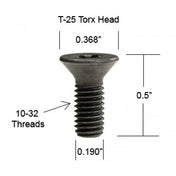
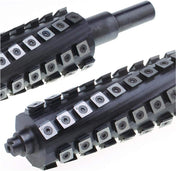
These are typically insert-carbide "wing" style cutters (Whiteside 6210, 6220, SB25-2, SB40-3) so the carbide inserts can be indexed or replaced without buying a whole new bit — a meaningful cost saver given how often a spoilboard needs a fresh skim.
7. CNC 2D/3D Signmaking & Lettering Bit Sets
For shops running 3D V-carve toolpaths (where the software combines a V-bit with a straight or ball-nose bit to carve varying depths for a sculpted, dimensional letter look), manufacturers sell purpose-built multi-piece sets that cover the common angle range in one purchase.
Amana's AMS-150 and AMS-225 packs, for example, bundle 45°, 60°, 90°, and 120° insert V-groove cutters together — everything you need for both bold outline carving and fine 3D detail work in a single kit, sized for either 1/4" or 1/2" shank routers/spindles.
Quick Reference: Matching the Bit to the Job
| Task | Best Bit Type |
|---|---|
| Bold, tapered V-carved lettering | 90° V-groove bit |
| Fine detail V-carving, small text | 60° V-groove or engraving bit |
| Single-line engraved text, awards, plaques | Pencil-point or flat-point engraving bit |
| Sculpted/rounded lettering, decorative fluting | Round nose (core box) bit |
| Cutting acrylic, PVC, ACM/Dibond, or aluminum panels on a CNC | O-flute single-flute spiral bit |
| Clearing background material, cutting outlines | Spiral upcut/downcut bit |
| Flattening the CNC spoilboard | Spoilboard surfacing cutter |
| 3D dimensional CNC lettering | Multi-angle CNC signmaking bit set |
A Few Practical Notes
- Material matters. HDU and MDO cut cleanly with standard carbide-tipped bits at moderate speeds. Cast acrylic and polycarbonate like a sharper edge and slower feed to avoid melting/re-welding the chip. Solid surface and Corian benefit from solid carbide bits designed for that duty.
- Shank size affects rigidity. For deep V-grooves or larger-diameter bits, a 1/2" shank resists deflection far better than 1/4" — deflection is the enemy of crisp, symmetrical V-carved letters.
- Point length limits your depth of cut. A V-groove bit's "point length" spec (e.g., the 1/8" point length on the Whiteside 1500) is the maximum depth you can plunge before the bit's shoulder starts widening the groove unpredictably — always check this spec against your desired carve depth before programming a toolpath.
Whether you're hand-routing a single cedar business sign or running a production CNC shop cutting HDU park signs and aluminum panel letters all day, these seven bit categories — V-groove, engraving, round nose, O-flute, spiral, spoilboard, and multi-angle CNC sets — cover the overwhelming majority of what actually gets chucked into a router for signmaking work.